
We at Appdigitally understand that harnessing the full potential of mobile apps hinges on consistent optimization and user experience refinements. A/B testing stands as a fundamental step in this relentless pursuit, providing a methodical approach to enhancing app performance.
It’s not simply about making changes; it’s about making the right changes, informed by real user data. This post is your guide to crafting meaningful A/B tests that will steer your app development in a direction that resonates with your audience.
Key Aspects of Mobile A/B Testing
Mobile A/B testing is the secret sauce behind successful apps. Imagine you’re a chef fine-tuning a recipe; every ingredient and measurement could make or break the dish. Similarly, every tweak in an app’s design or feature could lead to a hit or a miss in the app marketplace. The beauty of A/B testing lies in its ability to take the guesswork out of app optimization by presenting variants to real users and letting data drive your design decisions.

Why A/B Testing is a Game Changer
It’s simple—A/B testing is about learning what works best. We’ve witnessed giants like Facebook and Amazon leveraging A/B testing to skyrocket user engagement and revenue. They don’t play a guessing game; they base changes on solid data derived from user interactions. It sheds clear light on user preferences, fits new features with user needs, and directly correlates choices to app performance.

Pinpointing the Metrics That Matter
Imagine flying a plane with a blindfold. That’s what it’s like to change app features without tracking the right metrics. Success in mobile app A/B testing hinges on identifying and analyzing key performance indicators. The critical metrics include:
-
User engagement rates: How often are users interacting with your app?
-
Conversion rates: What percentage of users are taking desired actions?
-
Retention rates: Are users returning to your app after their first visit?
-
Revenue per user: Are your monetization strategies effective?
An A/B test could, for example, vary the text of a call-to-action button to see if “Buy Now” yields more conversions than “Shop Today”. By tracking these conversions, we measure the true impact of words on user behavior.
When you establish clear metrics, it’s like having a compass guiding your A/B tests. It points you towards the changes that yield significant improvements, instead of wandering in the world of endless iterations.
Follow the Data, Lead the Market
To sum up, A/B testing isn’t just a buzzword; it’s an indispensable tool in the mobile app optimization arsenal. Properly identifying and monitoring key metrics can transform insights into a concrete action plan. Armed with the right data, every decision becomes an informed step towards a richer user experience and a more profitable app. Remember, in the land of app development, the one who tests is king.
For those venturing into the world of A/B testing, our comprehensive posts on successful mobile app strategies and app marketing can serve as your roadmap, offering practical tips and real-world strategies to guide your journey.
Crafting Effective A/B Tests
Embarking on A/B testing requires a strategic approach to experimentation. A well-designed A/B test can lead to substantial improvements in user experience and app performance. Here are actionable insights for setting up A/B tests that can drive meaningful results.
Building Solid Hypotheses
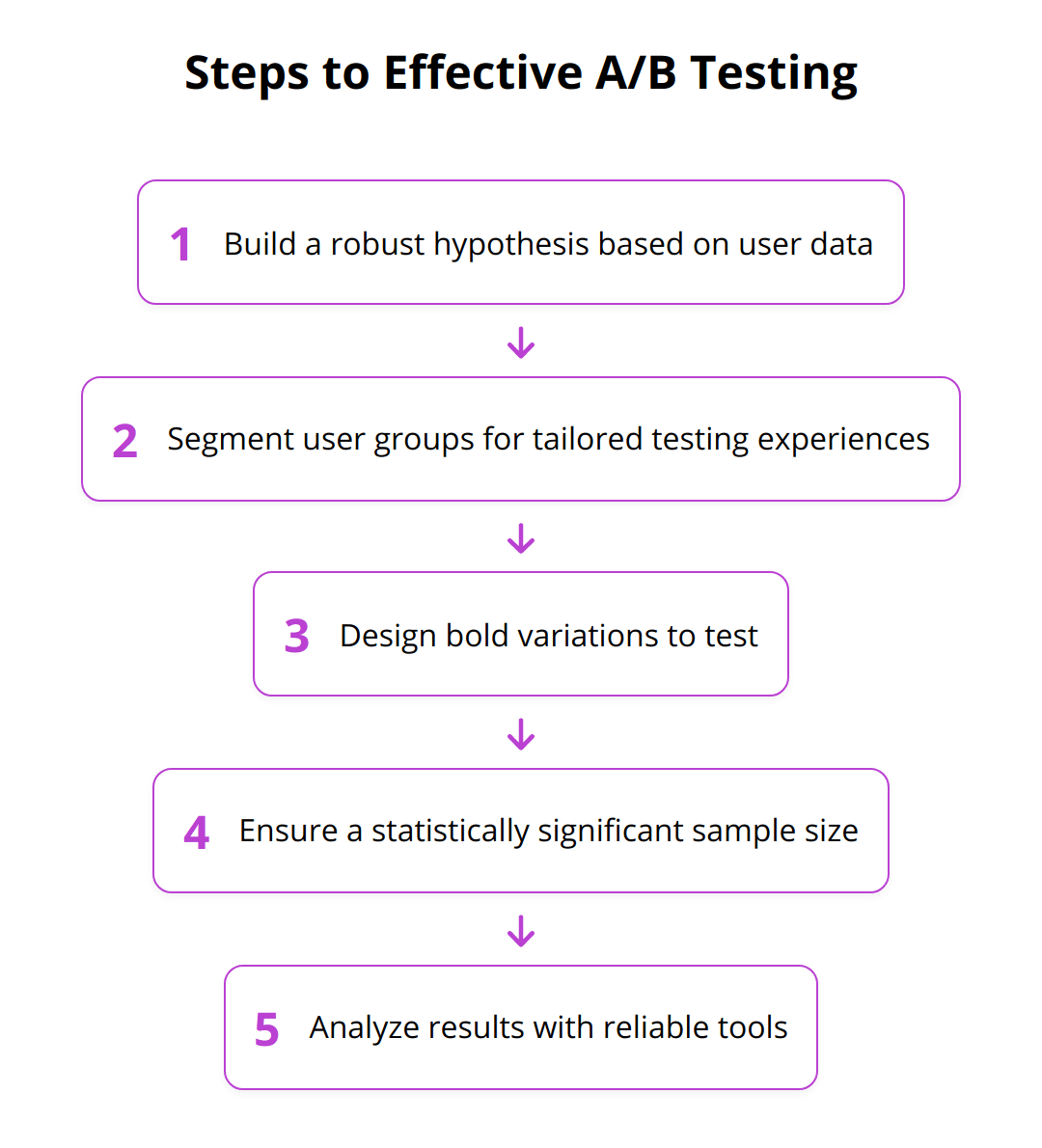
A robust hypothesis acts as the backbone of any A/B test. It should be specific, measurable, and based on insights from user behavior or industry benchmarks. For instance, if data suggests that users abandon a shopping cart at the payment information screen, one might hypothesize that simplifying the checkout process will increase conversions. Before moving forward with changes, thoroughly review your app analytics to pinpoint potential friction areas that could benefit from optimization.
Segmenting Users Intelligently
User segmentation is fundamental to A/B testing efficacy. Not all users will behave the same way, so tailor the test experiences to different user groups for more precise insights. You might segment users by demographics, behavior, or lifetime value. If, for example, you notice that new users are less likely to make in-app purchases, you might target them with a variation designed to build trust and offer value.
Testing with Statistical Relevance
Variations must be significant enough to detect a clear difference in performance. Minor changes often yield inconclusive results. Make bold variations that are still aligned with your app’s brand and purpose. Moreover, ensure that your test reaches a sample size capable of providing statistically significant results. Tools and services like Optimizely or Apptimize can assist in determining the needed sample size and analyzing the outcomes.

Remember, successful A/B tests take more than just a good hunch. They require meticulous planning, execution, and analysis. Here are quick tips to keep at the forefront of your A/B testing journey:
-
Verify the hypothesis with existing user data.
-
Target the right segments for more relevant results.
-
Opt for bold, noticeable variations to test.
-
Be patient to reach statistical significance.
-
Use trustworthy tools to measure and analyze results.
By adhering to these principles, you can optimize your mobile app in a way that enhances the user experience and drives business success. The next chapter will delve into refining your A/B testing approach and interpreting the data to make informed decisions for your app’s future development.
Tracking A/B Test Performance
Navigating the sea of data generated by A/B testing requires precision tools. Once you’ve implemented your A/B tests, the next critical step is analyzing the results to unveil the effectiveness of each variation. Employing robust analytics tools is paramount in decoding user responses and predicting future behavior.
Harnessing Comprehensive Analytics Tools
To gain actionable insights, you must arm yourself with analytics tools that do more than merely scratch the surface. Platforms such as Firebase Analytics offer real-time data that can help you monitor user interactions closely. When every action counts, having a live feed of user responses to your A/B tests can prove invaluable.
Moreover, analytics tools should empower you to segment data meaningfully. Understanding how different user groups respond to each app variant sheds light on diverse user preferences and behavior patterns. This granularity is the cornerstone for driving strategic improvements in your app.
Deciphering Test Outcomes
Interpreting A/B test results is less about numbers and more about comprehending what they signify. A positive uptick in user retention or conversion for one variant over another tells a powerful story about what your users prefer. Dive deep into the nuances of these results to:
-
Evaluate the success of the A/B test against your primary goals.
-
Understand why a particular variant outperformed the other.
-
Make informed decisions on whether to roll out the change.
Consider the context of your data to prevent skewed perceptions. Seasonal trends or external market influences can impact user behavior, and discerning these subtleties is critical for accurate analysis.
Data-Driven Decisions: The Way Forward
The data from your A/B tests are the compass for your app’s journey. They provide direction, highlight obstacles, and unveil potential opportunities. Here’s how to steer based on the data:
-
Align test results with your business objectives to ensure relevance.
-
Be wary of anomalies or outliers that may distort your analysis.
-
Scale winning changes cautiously to safeguard against unforeseen variables.
Merge quantitative findings with qualitative user feedback for a holistic approach. Tools like UXCam can complement A/B testing data by capturing user sessions, giving you a window into the ‘why’ behind the ‘what’.

Wrapping Up
In a landscape where margins for error are slim and competition is fierce, effective A/B test analysis stands as your strategic ally. With data as your guide, every tweak and change in your app can contribute to an upward trajectory in user satisfaction and business growth. Upholding this meticulous mindset throughout your A/B tests ensures that enhancements are always attuned to user needs and market demands. Keep a keen eye on the analytics, and let data-driven decisions chart the course for your mobile app’s future success.
Wrapping Up
As we bring this discussion to a close, it’s evident that the significance of A/B testing in mobile app development cannot be overstated. By methodically evaluating variations and relying on concrete data, A/B testing propels apps beyond mere functionality into experiences that users embrace and return to time and again.
![Key Takeaways - Mobile App A/B Testing [Pro Tips]](https://appdigitally.com/wp-content/uploads/2024/01/Mobile-App-AB-Testing-Pro-Tips-6-2024-01-31-070857.5776140000.png)
Continuous testing and iteration stand as pillars for app optimization, ensuring that developers and marketers alike can adapt swiftly to user preferences and market dynamics. The message is clear: test, learn, and refine to keep your app at the forefront of user satisfaction.
We at Appdigitally are committed to the mastery of A/B testing as part of our mission to turn innovative ideas into thriving apps. Harnessing over a decade and a half of industry expertise, our team ensures that A/B testing is integrated into the fabric of each app’s development journey. It’s through this relentless dedication to optimization that we deliver:
-
Enhanced user interaction
-
Elevated conversion rates
-
Improved app retention
-
Maximized revenue potential
Engage our services at Appdigitally and partner with a team that understands the intricacies of mobile app optimization. Together, we can craft unparalleled digital creations that stand the test of time and technology.
The takeaways are simple yet profound:
-
Prioritize A/B testing within your development strategy.
-
Let data guide your iterations for proven success.
-
Embrace continuous refinement for enduring app relevance.
With these practices, your app is not just part of the digital landscape; it’s shaping it.