If you’re reading this post, you probably want more app downloads and a better app performance. And that’s a good thing. Because that puts you ahead of people who would do nothing even when their apps seem to be under-performing.
However, you can’t afford to sit around and wish your app takes on wings. You need app store optimization tools to help you. There are some pieces of information you can’t have access to without the necessary tools.
How can app store optimization tools help you to improve your app’s performance, downloads, and usage? Some of the ways these tools can help you are:
- App Store Intelligence: These tools provide information like the app market trends and information about your competitors. You can compare your app performance with your competitors and see where they’re doing better than you.
- A/B Testing: You can improve important metrics for your app through testing to detect what your users prefer. These tools help to test elements in your app and your app product pages to get the best performances possible.
- App Product Page Optimization: With the analysis of your app page and how your audience interacts with it, these tools can give suggestions on changes you can make to your app name, icon, screenshots, description, pricing, etc.
- App Keyword Optimization: Many users perform a search when looking for an app. Do you know the keywords they search for when looking to solve a problem that your app can solve? You can get keyword suggestions, optimization, and tracking from these apps.
- Review and Sentiment Analysis: For current users of your app, the main way to tell you what they think about your app is through the ratings and reviews on various app stores. There are tools that help you to reply to reviews on your app store pages and also send app rating prompts to users when they’re likely to give 5-star ratings.
Without further ado, let’s consider tools that you need to get the performance, downloads, and revenue that your app deserves:
1. App Annie
App Annie is one of the most popular tools for app store optimization. This app offers analytics and app market data for both developers and marketers. There are many features that make it robust if you need to improve performance for your app.
It offers app store chart statistics like downloads and your rank in different countries and categories. Likewise, you can track the usage and engagement levels on your app. If you run adverts on your app, you can get statistics on its performance and the overall amount of revenues your app is generating.

You can also track the historical data of your downloads and revenue to check for improvements.
And if you want a visual representation, you can get graphs and charts that represent these values. Some other functions that App Annie perform are competitive analysis and industry trend prediction.
You can see how your competitors are performing and what features to add to your app based on new trends. App Annie is available on both Apple app store and Google Play Store. It also offers a free account with limited features.
2. Keyword Tool
Having the knowledge of the search terms users are searching for gives you an edge in performing your app store optimization to target those keywords.
When you consider that most people search when they’re about to download apps, then it’s an important factor if you want to increase your app downloads.

Keywordtool.io uses the App Store autocomplete to find all the similar keywords to a term. This is important as keywords that appear in autocomplete are keywords that other users have actually searched for.
However, this tool gives you a much larger list than what you normally see in the app store.
3. Sensor Tower
One of the main functions of Sensor Tower is to help increase your app downloads. It helps you to find keywords that your potential users are using in-app search.
This enables you to develop an effective plan that will make your app rank high for these keywords.

Furthermore, you can catch up with what your competitors are doing. There are custom alerts that keep you updated about changes your competitors are making to their apps and other moves. How effective are the ads on your app?
You can track top mobile advertisers and see what’s working for them and how you can do better. It offers a free limited version where you can track a single app.
4. AppFollow
Responding to users feedback on time give an impression you care about their views. But you can’t live on your app page expecting every app feedback. That would be a waste of time. Not cool.

However, AppFollow ensures that you don’t lose any opportunity to respond to your users’ feedback. Apart from having more satisfied users, this is also a positive signal to potential users about the quality of your customer support.
Apart from customer support, AppFollow also helps you to get information about your app’s status in the mobile app stores and optimize it for marketing.
This tool can be integrated with other tools like Zendesk, Intercom, HelpScout, etc. With its export feature, you can easily share with your team.
5. SearchAdsHQ
SearchAdsHQ helps you to optimize Apple app store ads for registrations, subscription, and purchases. You can use any event to track goals that indicate success for your app. The tool also helps you to track and improve in-app sales.

The tool shows you keywords that are likely to attract paying users to your app.
Likewise, you can see the competition level for these keywords. You can also save top performing keywords for future campaigns.
6. AppTrace
This app provides sentiment analysis for your app. This is drawn from reviews of your app. AppTrace judges the reviews based on positive feedback, addictiveness, and crash complaints by users.
Without browsing through all your user reviews, you can know the major issues users have with your app by the number of reviews talking about it.

You can also see the trends of these scores over time. With these metrics, it’s easy to track users’ reactions to changes in your app.
You can track review keywords with the daily and global rank of your app. The main catch? AppTrace is free to use and any developer can get these insights.
7. SplitMetrics
To improve conversions on your app pages, you need to perform A/B tests to know what resonates best with your audience.
SplitMetrics allow you to A/B test different elements of your app page but without an effect on your real download page. SplitMetrics gives you a link that you can send traffic to and thereby seeing the effects of your changes.

When your split tests produce considerably better results than your control, then you can implement these changes on your app page. Elements you can split test are:
- Title
- Icon
- Screenshots
- App description
- Video
For instance, by testing portrait screenshots against a landscape, Rovio was able to increase the conversion rate for Angry Birds 2 by 13%.

With testing on this tool, you can evaluate metrics like:
- App Conversion rate
- Engagement rate
- CTR
- Average time on page
- Time spent before installing an app
With this app, it becomes easier to test your apps.
8. StoreMaven
This is another tool that helps you to perform A/B tests on your app. It focuses on how you can increase your click-through rate and app installs rather than vanity metrics.
You can test elements like icons, images, and descriptions that perform best in getting potential users to download.

You can also benchmark your app conversions against competitors to see opportunities for improvements.
StoreMaven directs test traffic to an app product page clone to get the result of how those changes will affect conversions.
It has a predictive testing algorithm, StoreIQ, which identifies and closes low performing variations and can also access a test’s significance faster and more accurately.
By using this tool, Kabam was able to reduce its cost for paid and organic installs and increase install conversion by 66%.

9. AppsFlyer
To increase your app downloads, it’s necessary to know the sources of your current downloads. With this knowledge, you know the channels to focus your marketing efforts.

With AppsFlyer, you get the report of user acquisitions and engagement levels. In another sense, this tool can help you track the effectiveness of each of your marketing channels with regards to how they’re driving installs.
You can also grant access to a third party and restrict their access to whatever information you want them to see.
10. Adjust
This tool allows you to track app store statistics, advertising sources, and real-time user behavior on your app.
You can know the number of app installs and their source. With this, you can know the effectiveness of your marketing channels and the number of installs they’re driving. It can also track in-app transactions and subscriptions by users.

Adjust is easy to use as you can integrate it with third-party campaign channels like Facebook, Twitter, Google, SnapChat, SoundCloud, etc. More so, you can measure impressions, sessions by users, click on ads if you run ads in your app, click on any menu in your app, and other metrics.
11. Apptentive
Most times, users don’t rate or review apps. Developers need to prompt them from the app for them to rate the app and leave a review.
However, showing these prompts at the wrong time may be counterintuitive. If the prompt itself annoys the user, that can lead to a negative review.
The key is sending a prompt to users at the time they’re enjoying the usage of your app. Most users will rate your app based on their current feelings unless there’s a big issue they’ve been dealing with.

With apptentive, you can understand customer sentiment before asking them for a review. If they don’t love your app, you can lead them to a page where they can give you feedback or fill out a survey. You can specify moments that matter to you like the best time for the prompts.

12. Mobile Action
Mobile Action provides data that helps you to market your app. You can perform keyword research using this tool in order to identify important keywords that will improve your visibility and downloads in the app store.
You also get related keywords to your main keyword which can open up other opportunities.
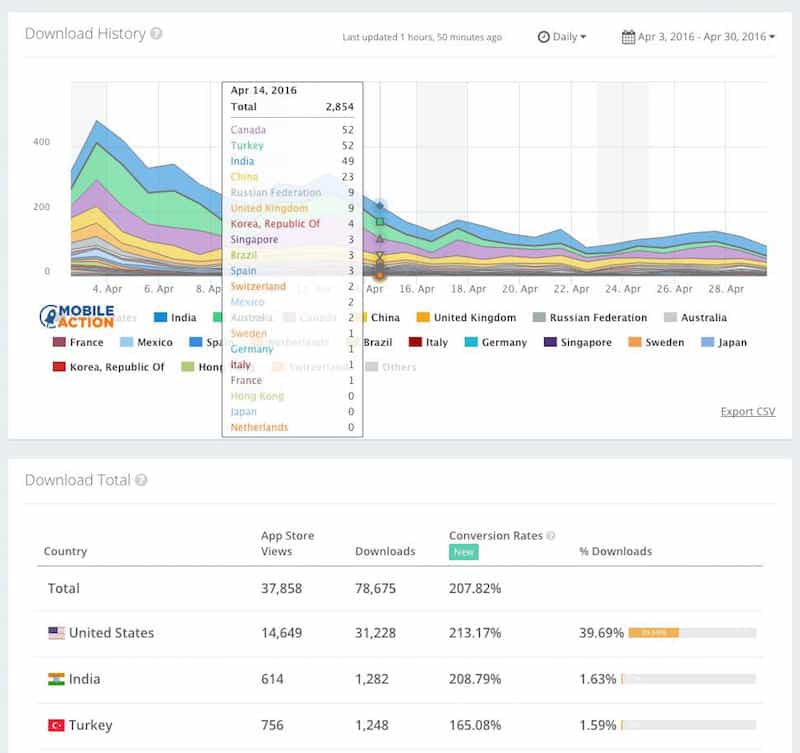
Apart from this, Mobile Action offers a competitor analysis. You can compare their rank with yours for the keywords you’ve chosen. You can also get information about the keywords they rank for.
For any keywords you try to optimize your app for, you can see the apps that are ranking at the top. You have access to other data like your competitor’s download history, daily and hourly category ranking, and even rank in different countries.
13. TUNE
This app gives you data about attribution. You can measure the impressions, ad clicks, app installs, and in-app events. When you spend to advertise your app on various channels, you can track its effectiveness through the source data for your app installs.

It also provides tools for audience segmentation, A/B testing, and delivery of in-app messaging and Push notifications.
14. App Radar
App Radar tool helps in your app keyword optimization. With this tool, you can see your app’s rank for important keywords and also check for different countries. Apart from this, you get keyword suggestions that you should target. And if you run more than one app, you can manage them on a single dashboard.

You can perform competitor analysis and see how their apps perform for the important keywords you’re targeting. With this tool, you can improve your visibility in search and get more app downloads.
15. TheTool
This app store optimization tool helps you to track app charts, keyword rankings, conversion rate, number of installs, and user ratings of your app. TheTool provides a scorecard that gives you insight into various elements of your app to improve to give it a better chance of ranking in app search.

It provides daily and all-time user ratings, daily conversion rates and in different countries, and also revenues from ad monetization. The tool provides organic uplift which shows you the number of downloads needed to reach the top position in the top charts.
Final thoughts
App store optimization is a necessity if you want your mobile app to perform and reach the number of installs and level of engagement you want.
With these app store optimization tools, you can improve different aspects of your app’s performance in the app store and make your app exciting and discover-able for the target users.